
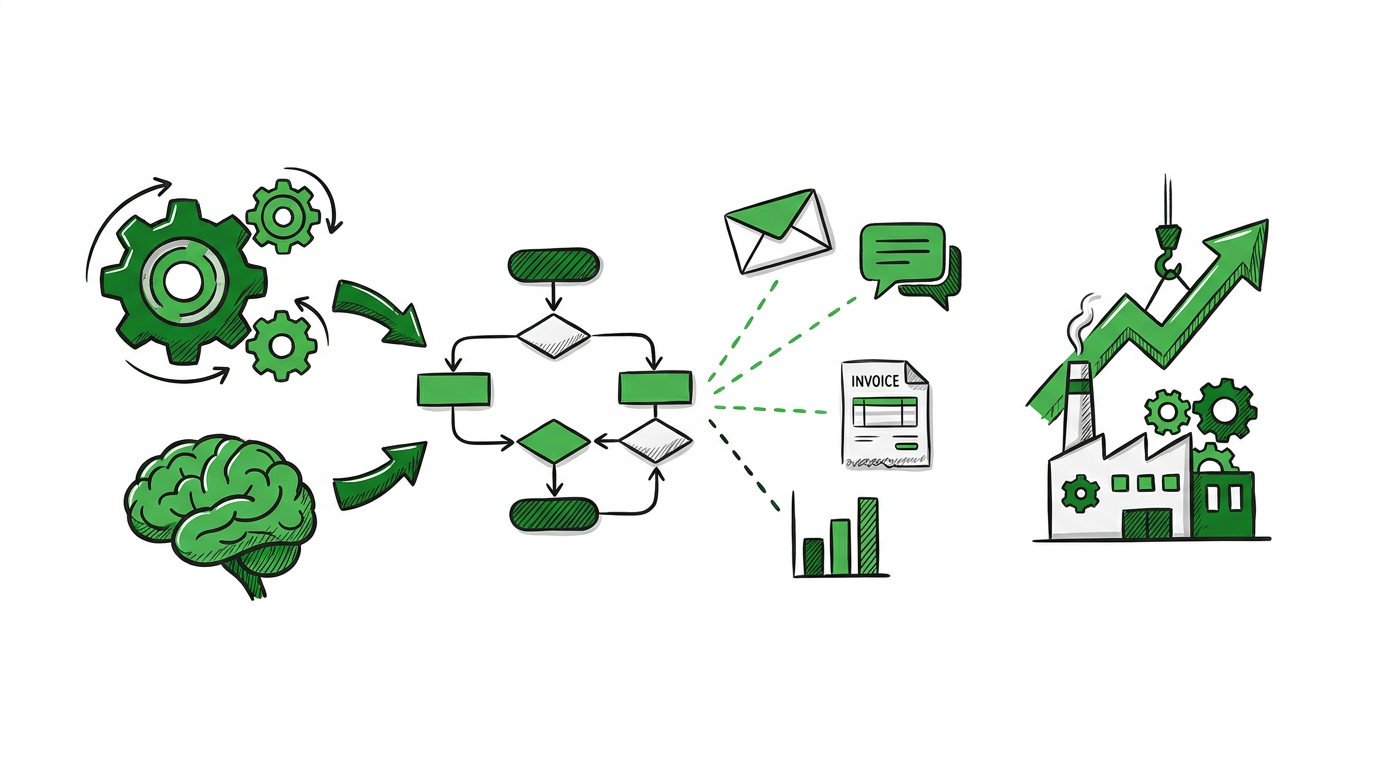
A new enquiry arrives through your website at 8.40 pm. Another customer sends a WhatsApp message, while a third submits a Facebook form. By the next morning, the details sit in different inboxes and nobody is certain who should reply.
That fragmented process is what an AI growth platform should fix. Techno Ape approaches the problem as one connected customer journey rather than a collection of unrelated tools.
Quick answer: how to implement an AI growth platform in Malaysia
For most Malaysian SMEs, automate the customer journey in this order:
- Map every place where leads and customer messages arrive.
- Send all new contacts into one customer record system.
- Automate an immediate acknowledgement and route the conversation.
- Build structured follow-up for leads that do not respond or buy.
- Trigger review requests after a confirmed positive experience.
- Use customer history to run retention and reactivation campaigns.
- Measure response time, conversion, reviews and repeat business monthly.
Do not begin by automating every department. Start with one high-volume customer journey, prove that the data moves correctly, and then extend the workflow.
What an AI growth platform does for a Malaysian SME
An AI growth platform connects the systems involved in acquiring, serving and retaining customers. A practical setup usually includes lead capture, a customer database, messaging, automated follow-up, review requests and reporting.
AI can help classify enquiries, draft or send approved responses, summarise conversations and decide which workflow should run. It should not be given unrestricted control over sensitive conversations. Refund disputes, medical questions, complex quotations and angry customers still need human judgement.
For a Malaysian business, channel coverage matters. Customers may discover the company through Google Search, Google Maps, Instagram, Facebook or a referral, then choose WhatsApp for the actual conversation. A conventional CRM can store their contact details but still leave staff copying messages between screens.
The useful test is simple: can the business follow one person from first enquiry to repeat purchase without manually reconstructing the history?
Consider a fictional air-conditioning service company in Petaling Jaya called CoolBreeze Services. It receives leads from its website, calls generated through its Google Business Profile, Facebook forms and WhatsApp. The office administrator maintains a spreadsheet, while two technicians keep separate customer contacts on their phones.
A homeowner named Aina submits a website form asking for a service appointment in SS2. The form email reaches a shared inbox at 7.15 pm. Nobody replies until 10.20 am the next day, by which time Aina has contacted two other providers.
An AI growth platform cannot make CoolBreeze competitive if its service is poor. It can stop a valid enquiry from being ignored, route it to the right person and preserve the conversation for later follow-up.
Step 1: map lead capture before adding AI business automation
List every customer entry point first. For CoolBreeze, that means the website form, telephone calls, WhatsApp, Facebook lead forms, direct messages and Google Business Profile interactions.
Export the last 90 days first. Compare the records with invoices or completed appointments, then identify which source labels and contact details are consistently available.
The exercise often reveals operational gaps that software alone will not solve. One form might collect a phone number but not the service location. Staff may record phone enquiries without noting how the caller found the company. A social media form may use different service categories from the website.
Standardise the minimum information required for a usable lead:
- Name and preferred contact channel
- Mobile number or email address
- Requested product or service
- Location or service area
- Lead source
- Date, time and consent record
Keep the form short. Every extra compulsory field adds friction, especially on mobile. Ask only for information required to make the next useful decision.
CoolBreeze changes its website form to collect the customer’s name, mobile number, postcode, property type and requested service. It does not ask for the air-conditioner model at this stage because many homeowners do not know it.
The submission should create or update a single customer record. If Aina later sends a WhatsApp message using the same mobile number, staff should see the earlier website enquiry rather than a second disconnected lead.
Malaysia’s Personal Data Protection Act applies to the processing of personal data in commercial transactions. Review the requirements published by the official Personal Data Protection Department and obtain appropriate advice for your business rather than copying another company’s consent wording.
Record why the data was collected. Do not quietly add every service enquiry to indefinite promotional broadcasts.
Step 2: create one customer record for each lead
A small-business CRM becomes useful when it functions as the operating record, not merely an address book. Each contact should show where the person came from, what they asked for, who owns the next action and what happened afterward.
Define a short pipeline that matches how sales actually happen. CoolBreeze uses New Enquiry, Contacted, Appointment Proposed, Booked, Completed and Lost. It avoids vague stages such as Warm and Hot because two staff members may interpret them differently.
Set clear rules for movement between stages. A lead reaches Contacted only after a staff member or approved automation has sent a message. It reaches Booked only when the date and time are accepted. Completed means the service took place, not that an invoice was created.
Duplicate contacts are a common failure mode. A customer may submit a form as “Aina Rahman” and later appear in WhatsApp as “Puan Aina”. Mobile number matching can reduce duplication, but shared family numbers and changed numbers require manual review.
Ownership matters too. Assign each new lead to a person, branch or queue. If a contact has no owner, an automated reminder simply alerts everyone while holding nobody accountable.
For CoolBreeze, website enquiries from Petaling Jaya enter the office queue. Requests outside its normal service area are flagged for review rather than receiving an automatic promise of availability.
Use AI to summarise long message threads or suggest a category, but retain the original conversation. Staff need to verify what the customer actually said.
Step 3: automate customer conversations without trapping people
An immediate acknowledgement is valuable when it sets expectations. It becomes irritating when it pretends the customer’s problem has already been understood.
After Aina submits the form, CoolBreeze sends a short WhatsApp message confirming receipt, repeating the requested service and asking for a preferred appointment window. The message states that the team will confirm availability during operating hours.
That is more useful than “Thank you for contacting us. We will get back to you soon.” It moves the booking forward.
WhatsApp automation also carries constraints. Businesses must consider customer consent, approved message formats and the rules that apply when starting conversations outside an active service window. Meta documents these requirements in its official WhatsApp Business Platform documentation.
Design the automated conversation around a few high-confidence tasks:
- Confirm that an enquiry was received
- Collect one or two missing details
- Answer approved frequently asked questions
- Offer valid appointment or callback options
- Transfer uncertain cases to a person
Always provide a clear human route. A chatbot should not continue asking the same question after the customer has explained that the available options do not apply.
For CoolBreeze, pricing questions are not answered with a fabricated fixed quote. The system can explain that the final amount depends on unit type and condition, collect a photo if appropriate, and assign the conversation to the service coordinator.
Language needs attention in Malaysia. Some companies serve customers in English, Bahasa Malaysia, Mandarin or a mix of languages within the same conversation. Test common colloquial phrases and spelling variations. If the system is uncertain, ask the customer which language they prefer or hand the message to staff.
Step 4: build automated customer follow-up
Many SMEs focus on the first reply but have no reliable process for the second or third contact. A lead receives a quotation, goes quiet and disappears from the spreadsheet.
Follow-up should depend on the customer’s stage and behaviour. A generic daily reminder sent to every open contact will create noise for staff and customers.
CoolBreeze uses separate sequences. A new enquiry that has not replied receives one reminder the following business day. A customer who requested an appointment but did not confirm receives a message referencing the proposed slot. A completed job does not remain in the sales sequence.
The workflow pauses when the customer replies. This detail prevents the embarrassing situation where an automated “Are you still interested?” message arrives while a staff member is already discussing the booking.
Set an end condition. Three or four messages spread over an appropriate period may be reasonable for some considered purchases, while an urgent home service needs a shorter window. There is no universal sequence.
The content should also change between attempts. Repeating the same request is not a strategy. One message can answer a common concern, another can offer help choosing the service, and the final message can close the enquiry politely.
CoolBreeze discovers another issue during testing. Its follow-up runs on public holidays because the workflow treats every weekday alike. The message promises a same-day response when the office is closed. The fix is to use the company’s actual operating calendar and make the promise conditional.
Monitor opt-outs and negative replies. More automation is not always better. If customers frequently ask the business to stop messaging, review the timing, wording and legal basis for the contact.
Which customer tasks should you automate first?
The best starting task has enough volume to matter, a clear trigger and a predictable next action. It should also carry limited risk if the automation gets something wrong.
| Customer task | Recommended stage | Main benefit | Human control needed | Key failure risk |
|---|---|---|---|---|
| New lead acknowledgement | Start first | Faster response and clear expectations | Review exceptions | Promising unavailable service |
| Lead assignment | Start first | Clear ownership | Maintain routing rules | Leads sent to absent staff |
| Unanswered lead follow-up | Start early | Fewer forgotten enquiries | Approve timing and wording | Messaging after a customer replied |
| Appointment reminders | Start early | Fewer missed appointments | Handle rescheduling | Incorrect dates or time zones |
| Review requests | Add after service status is reliable | More consistent feedback collection | Respond to feedback | Asking before the job is resolved |
| Retention campaigns | Add later | More repeat business | Define useful segments | Sending irrelevant offers |
| Complex support decisions | Keep human-led | Protects customer trust | Full human ownership | Incorrect or unsafe advice |
This order matters. Review and retention workflows depend on accurate customer stages. If the platform cannot reliably tell whether a job was completed, it cannot safely decide when to request a review or invite a customer back.
Step 5: automate Google review requests at the right moment
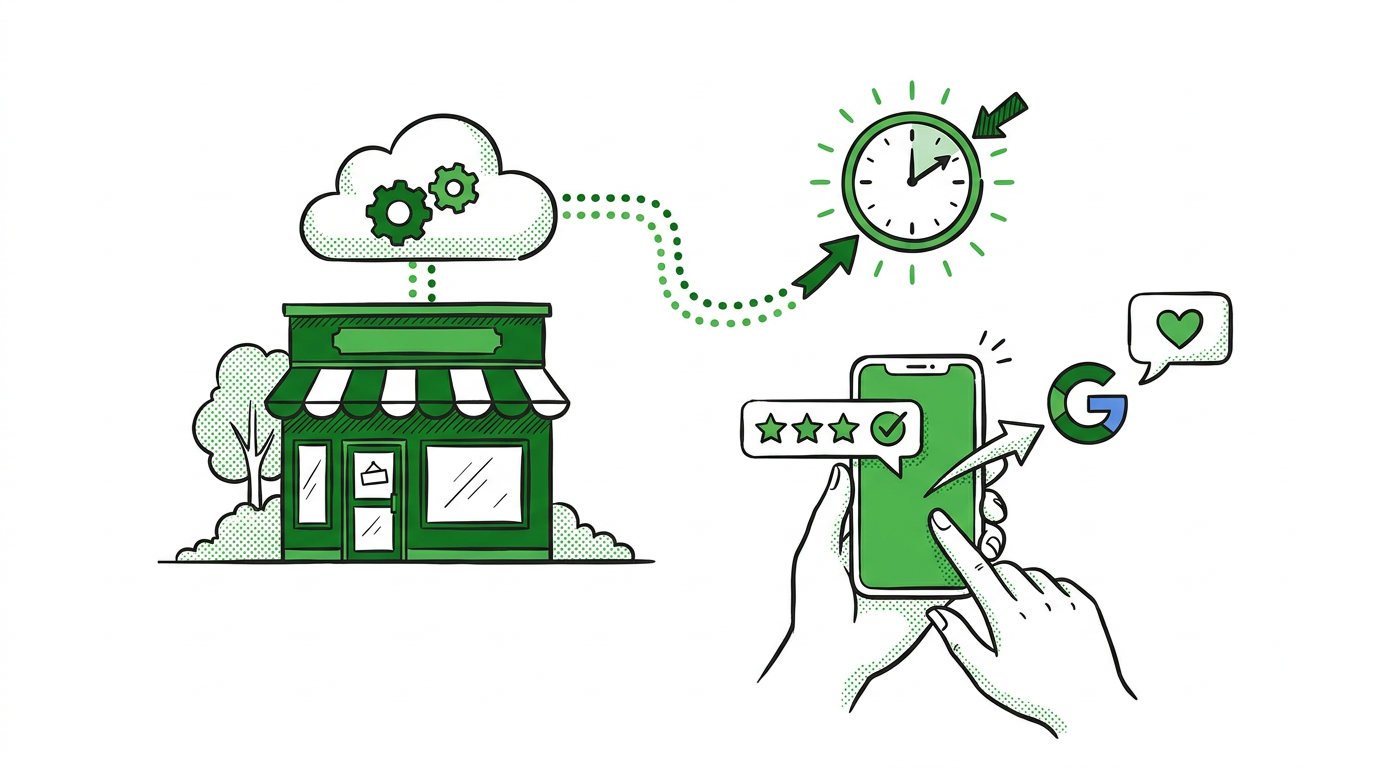
Review requests should follow a real service event. Do not send them simply because a person’s mobile number exists in the CRM.
CoolBreeze triggers the request after a technician marks the appointment Completed. The first message asks whether everything was resolved. If the customer reports a problem, the system opens a service recovery task. If the customer confirms a satisfactory experience, the business can provide a direct route to leave an honest Google review.
Do not offer rewards for positive reviews or prevent dissatisfied customers from expressing their experience. Google’s policies prohibit practices such as fake engagement and review manipulation. Check the current Google Maps user-contributed content policy when designing the workflow.
The request should identify the completed service and make the action easy. A vague message sent weeks later feels like bulk marketing.
Google Business Profile management does not end when the request is sent. Assign responsibility for reading and responding to reviews. Replies should address the specific service without publishing private customer information.
Negative feedback is operational data. If several customers mention late arrival, do not solve the issue by changing the review request. Fix scheduling and communication.
CoolBreeze initially makes the Completed stage available before payment and issue checks are finished. A technician closes a job despite a pending complaint, which triggers a poorly timed review request. The company adds a Resolved status and requires unresolved jobs to stay outside the review workflow.
Step 6: connect the AI growth platform to retention
Customer retention automation needs purchase or service history. A single broadcast to the entire database is not retention. It is an untargeted promotion.
Segment customers using information relevant to the next need. For CoolBreeze, that could include service type, completion date, property category and whether the customer consented to promotional messages.
A customer who booked routine servicing may receive a reminder when another service is reasonably due. Someone whose enquiry was marked Lost should not automatically enter the same sequence as a completed customer. A commercial property manager with multiple units needs different communication from a homeowner with one unit.
Start with one retention use case. Choose a service or product with a natural repeat interval and enough historical data to identify eligible customers. Confirm that dates and statuses are accurate before switching on any messages.
Retention workflows can include maintenance reminders, warranty check-ins, replenishment notices, membership renewal prompts or reactivation offers. Each one needs an exit rule. If the customer books, pause the sequence.
Personalisation should be based on verified data. Avoid inserting an old service detail into a message if it may no longer be relevant. A short accurate message is safer than an elaborate one built from poor records.
For broader guidance on connecting acquisition and retention workflows, visit the Techno Ape blog. New articles can sit alongside the operating playbook your team maintains internally.
How Techno Ape connects the growth workflow
Building this yourself means deciding how lead capture, conversations, follow-up, reviews and retention pass data from one stage to the next. Techno Ape’s role is to connect that sequence for Malaysian SMEs, reducing the number of hand-offs staff must manage.
The experience begins with the lead. A business identifies its active capture points and decides what information should enter the customer record. Instead of allowing website enquiries and customer conversations to become separate lists, the workflow is designed around one contact history.
Next comes the initial conversation. The business defines which acknowledgements and common questions can be automated, what operating hours apply, and when a staff member must take over. The objective is not to remove people. It is to remove the delay before the right person becomes involved.
Follow-up is then attached to actual customer stages. A new enquiry can receive a different sequence from an unconfirmed appointment. Replies and bookings must stop irrelevant reminders.
Once completion data is dependable, review requests can be triggered after the service outcome rather than sent as a bulk campaign. Unresolved cases return to staff for attention. Suitable customers receive a clear request for honest feedback.
Retention comes last. Customer history is used to identify who may reasonably need another service or follow-up, while consent and exclusions remain part of the workflow.
This sequence is the important part of an all-in-one system. A long feature list does not help if each function uses different records or staff still have to copy updates manually.
Businesses considering an AI growth platform in Malaysia can review Techno Ape as a starting point for discussing which customer journey should be connected first. Bring examples of real enquiries, current response templates and recent lost leads. Those materials expose process gaps faster than a generic feature demonstration.
How to measure an AI growth platform after launch
Measure the workflow from the customer’s perspective. Login counts and messages sent do not show whether service improved.
Track the time from a new enquiry to the first meaningful response. An automated acknowledgement alone should not count if it gives the customer no answer or next step.
Then measure stage movement. How many valid leads are contacted, how many reach a booked or won status, and how many are marked lost with a reason? Review the reasons monthly. “No response” is useful only if the follow-up process actually ran.
For review management, track eligible completed jobs, requests successfully sent, customer issues routed for recovery and reviews received. Do not judge employees only by star ratings, since service type, customer expectations and operational problems can affect the result.
Retention should be measured against completed repeat bookings or purchases, not message clicks alone. Keep a baseline from before automation where the records permit a fair comparison.
Audit a sample of customer journeys manually. Read the conversations from beginning to end. You may find that the dashboard looks healthy while customers receive duplicate messages or wait too long after asking for a person.
Common mistakes with AI business automation in Malaysia
The first mistake is buying several tools before documenting who owns each customer stage. Software then reproduces the confusion at greater speed.
The second is treating WhatsApp as an unlimited promotional channel. Consent, customer expectations and platform rules still apply. A mobile number collected for an appointment is not automatic permission for every future campaign.
Another mistake is automating unstable processes. If staff cannot agree what Completed means, a trigger based on that status will misfire. Fix the definition first.
Businesses also underestimate maintenance. Services change, staff leave, opening hours move and message policies are updated. Assign a workflow owner who tests forms, routing and stop conditions regularly.
Avoid allowing AI to invent operational facts. Approved answers should come from current business information, including service areas, opening times and escalation routes. Unknown questions should reach a person.
Finally, do not combine every contact list without checking source, consent and data quality. Old spreadsheets often contain duplicate records, incomplete numbers and customers who opted out elsewhere.
FAQ about AI growth platforms in Malaysia
What is the best AI growth platform for a Malaysian SME?
The best fit depends on the customer journey you need to connect. Prioritise reliable lead capture, shared customer records, WhatsApp-compatible workflows, clear human handover, review management and retention triggers. Ask the provider to demonstrate your real process rather than a generic sales pipeline.
Is an AI growth platform the same as CRM software?
Not exactly. A CRM primarily stores and organises customer relationships and sales activity. An AI growth platform may connect that record to conversations, automated follow-up, review requests and retention workflows. Check how the functions share data rather than relying on the product category printed on the website.
Can a small business automate WhatsApp follow-up?
Yes, provided the workflow respects consent, platform rules and customer preferences. Start with acknowledgements, appointment details and relevant follow-up. Include a human handover and stop messages when the customer replies, books or opts out.
How do I automate Google review requests?
Use a confirmed service or purchase event as the trigger. Ask whether the experience was resolved, route reported problems to staff, and give customers a simple way to leave honest feedback. Do not pay for positive reviews, create fake reviews or selectively pressure customers.
Should AI answer every customer message?
No. AI is suitable for defined questions and routing where the approved answer is clear. Pricing exceptions, complaints, sensitive personal information and unusual service requests should move to trained staff.
How long does implementation take?
It depends on the number of channels, data quality and workflow complexity. A focused implementation covering one form, one pipeline and one follow-up sequence is easier to test than a company-wide rollout. Set the sequence first, then ask providers for a scope based on that process.
Can an AI growth platform help with local SEO?
It can support parts of local visibility by making review requests consistent and helping the business manage customer responses. It does not replace accurate business information, useful local pages, sound technical SEO or good service. Review activity should reflect genuine customer experiences.
What should we automate first if our customer data is messy?
Begin with new leads rather than importing every historical record. Create consistent fields, pipeline stages and ownership rules, then clean older data in controlled batches. This prevents legacy duplicates from damaging the new workflow.
Choose one customer journey and make it reliable
A Malaysian SME does not need to automate its entire operation at once. It needs one dependable route from enquiry to response, follow-up, completed service, review and repeat business.
Start where valid leads are currently being lost. For many businesses, that means connecting website and WhatsApp enquiries to one customer record, assigning ownership and sending a useful first response. Add review and retention workflows only after service outcomes are recorded accurately.
Choose a platform when it reduces copying, missed follow-up and disconnected customer histories. Keep separate tools if they already exchange dependable data and staff can operate them without gaps. The practical choice is the setup that preserves context and makes the next action clear. Read next: Google Review Management in Malaysia: A Compliant Automation Guide. Read next: How to Automate Google Review Requests Without Losing the Personal Touch.
2 thoughts on “AI Growth Platforms for Malaysian SMEs: What to Automate First”